
Fistfights, barbecue and cannons: Rowdy behavior at the Lincoln-Douglas debates
By Michelle Tiedje
“Rowdy” may not be a word most people associate with the Lincoln-Douglas debates, which kicked off in Ottawa, Illinois one hundred and sixty-eight years ago today. The seven debates took place during the election campaign of 1858, as Abraham Lincoln competed against incumbent Stephen A. Douglas for a seat in the U.S. Senate. They demonstrated the prominent place slavery occupied both in American politics and the public mind at the time and established Lincoln as a leading voice for Republican values and a serious statesman. But the debates were also chaotic and rowdy public events. They drew large, often unmanageable crowds and occurred at a time of great political tension—a combination that encouraged aggressive displays of political affiliation and loyalty from attendees, heckling of both Lincoln and Douglas, often made it difficult to hear the speakers, and sometimes led to vandalism, fistfights, and street brawls.
Lincoln and Douglas’s political allies heavily promoted all their speaking events during the 1858 campaign season, and, when possible, hitched their proverbial wagons to other public events like local fairs, agricultural shows, or circuses to boost attendance. The debates were largely standalone events, however, and even circus tents weren’t large enough to hold the attendees for most of them. The sizes of the audiences at the Lincoln-Douglas debates varied from one debate to the next—and the estimates for audience size also varied depending on whether the newspaper reporting was Democratic or Republican—but they ranged from anywhere between 1,500 at Jonesboro to 15,000 and higher at Freeport and Galesburg. Few public venues at that time could hold even 1,000 people, so any event expecting higher attendance had to be held outdoors.
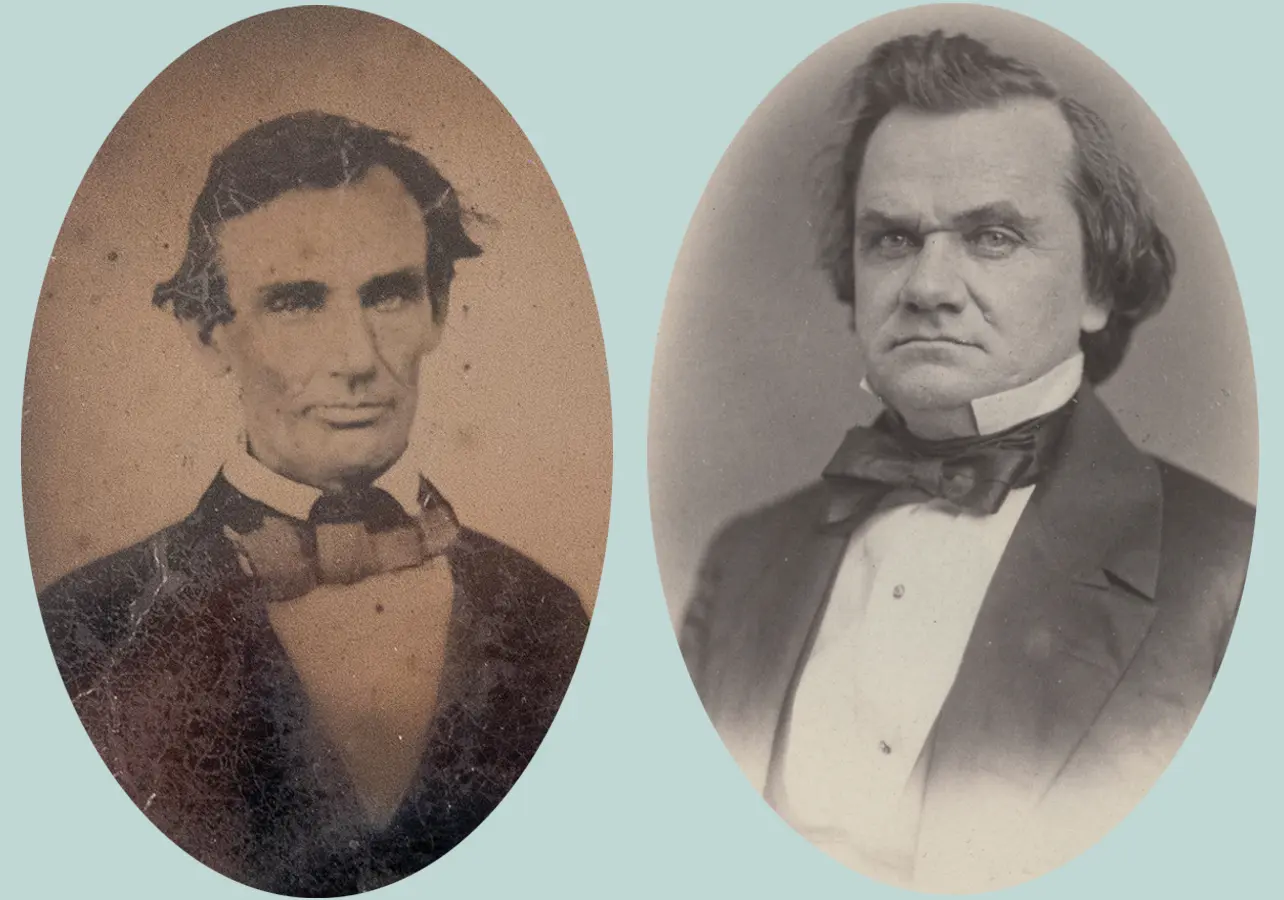 Abraham Lincoln in October 1858. (ALPLM) Douglas in 1859. (Library of Congress)
The debates took place outside, usually either on fairgrounds or in public squares. The state fair in Centralia in mid-September pulled people from their hometowns, and the debates in Jonesboro on September 15 and Charleston on September 18 benefitted from the influx of people. Sometimes food was also used to help attract attendees. The debate at Freeport on August 27, for instance, had a corner of the town’s courthouse square dedicated to a public barbeque. Beef was roasted over a ditch that reportedly measured six feet by six feet. But the large debate crowds created chaotic, uncomfortable conditions and strained local resources.
As the Chicago Daily Press and Tribune reported regarding the fourth debate, in Charleston: “People came on horseback and muleback, in wagons, in freight trains and on foot—some with badges and some with banners, some with their dinners and some without. At ten o’clock the streets and sidewalks around the public square were almost impassable, and those who essayed out-doors anywhere in the vicinity were well nigh stifled with dust for their pains.” In Ottawa the day before the debate, hotels, stables, and even private homes were full and late arrivals had to camp along the Illinois River. The next day, the debate started thirty minutes late simply because the crowds slowed Lincoln and Douglas’s arrivals to the speaker’s platform. Most of the debates also witnessed the arrival of special trains, pulling more cars than was standard, which delivered even more attendees.
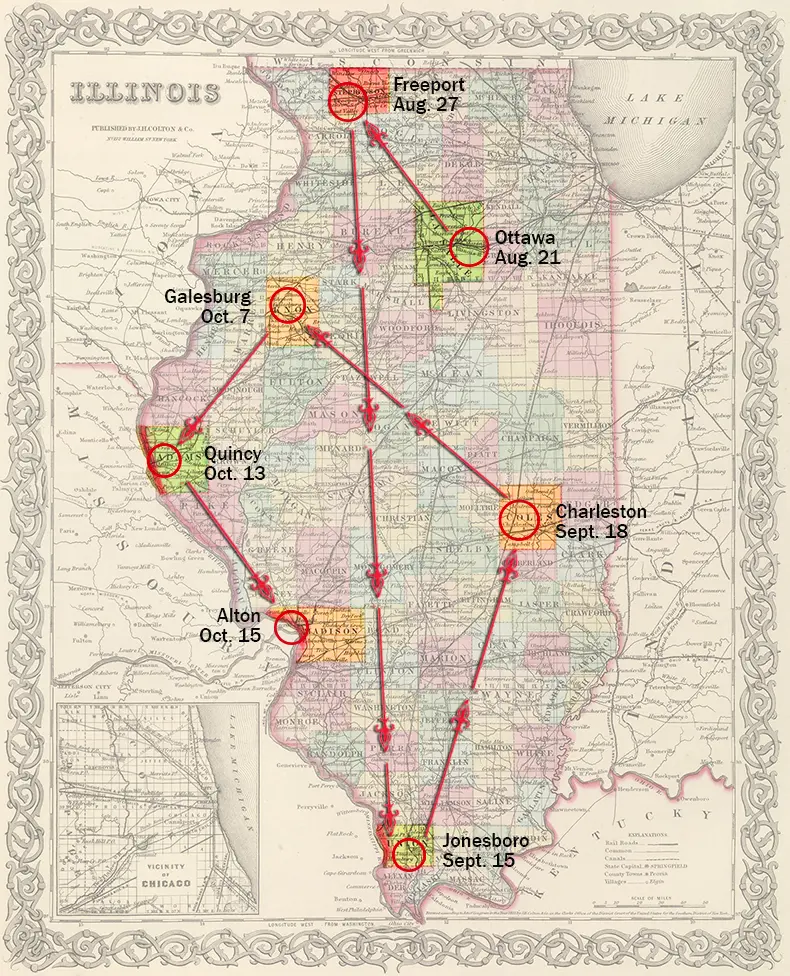 The debate dates and locations.
Lincoln traveled during the campaign using the complimentary railroad pass he held as a lawyer for the railroad, sometimes riding freight trains as well, and carried little aside from a battered carpetbag and umbrella. Douglas traveled with loud and boisterous pageantry in elaborately decorated private railcars that were reportedly well-stocked with liquor and with a large entourage, marching bands, fireworks, and a small cannon named “Popular Sovereignty” that was fired to herald his approach and otherwise gain the attention of the crowds. Liberal use of cannon fire before and after the debates was common (likely to the dismay of at least some attendees). During most of the debates, Lincoln and Douglas were each escorted around the debate towns by large groups of supporters, usually in heavily decorated carriages and accompanied by military companies and marching bands. Some of these processions reportedly stretched from half a mile to a mile long.
The Chicago Daily Press and Tribune reported that, at Ottawa, “National flags, mottoes and devices fluttered and stared from every street corner.” At each debate, supporters of both candidates flew banners and paraded props that needled their political opponents. At Charleston, for example, Republicans tried to hoist a banner over the speaking platform that portrayed Lincoln as a mastiff biting Douglas on the throat. The banner proclaimed, “Lincoln Worrying Douglas at Freeport.” Amid the ensuing upset, Lincoln asked for the banner to be removed. Pro-Douglas Democrats then tried to replace it with a banner emblazoned with the phrase, “Negro Equality,” which Republicans pulled down and tore to pieces. At the Quincy debate, a group of Lincoln supporters toted about a model ship representing the U.S. Constitution on wheels, drawn by four horses, filled with “sailors,” and helmed by a live raccoon. Some of Douglas’s supporters at Quincy drove a wagon nicknamed “Dred Scott” and hoisted a dead raccoon alongside their banners and mottoes. (Raccoons were a widely-recognized symbol for Henry Clay at the time, whose supporters both Lincoln and Douglas wooed throughout the campaign.)
At Charleston, a Republican band having a “little piece of malicious fun,” as the Democratic Daily Chicago Times reported it, played obnoxiously during a welcoming address for Douglas until forced to stop. During his approach to the speaker’s stand in Freeport, someone threw a melon at Douglas. It glanced off his shoulder and the crowd heckled him until he reminded them of the purpose for which they were gathered and that even political opponents deserved a fair hearing. Lincoln also had to quiet the crowds at times before he could speak. He handled hecklers at the debates as he did throughout most of his political career: by addressing them rather than ignoring them and using wit and humor to make the rest of the audience laugh. This proved an effective way to silence hecklers quickly. When a heckler at Alton interrupted him at the very start of his speech after Lincoln opened with, “Ladies and Gentlemen” by shouting out, “There are no ladies here,” Lincoln reportedly quipped, “You are mistaken about that. There is a fine chance of them back here.” (Women were present not only behind Lincoln, on the speaker’s platform, but also in the crowd. Lincoln was poking fun at the heckler to the audience for discounting such women as ladies.)
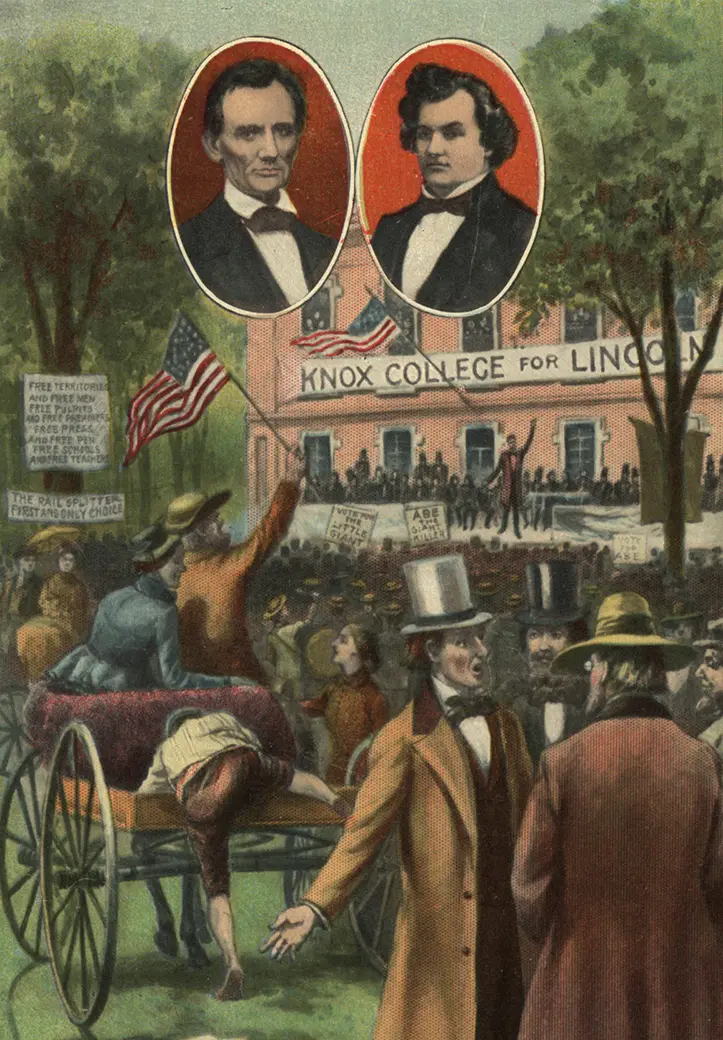 A 1908 depiction of the crowd at the Galesburg debate. (Courtesy of the Lincoln Financial Foundation Collection.)
Bonfires, torchlight processions, and enthusiastic celebrations often followed the debates and continued into the tender hours of the night or next morning. A joint Republican and Democratic organizing committee for the final debate, at Alton, banned “processions or other demonstrations of enthusiasm” as an attempt at crowd control after other debates saw political tensions spill into fistfights in saloons or even brawls in the streets. The Daily Illinois State Register also reported that, in between the Charleston and Galesburg debates, a special carriage provided to receive Douglas for a speech in Danville was vandalized “under cover of night” by being “soiled. . . in a manner unmentionable, so that it could not be used.”
The atmosphere surrounding the Lincoln-Douglas debates is difficult for us to fully imagine today. Amidst all the excitement and rowdiness of the crowds, Lincoln and Douglas produced a series of debates that captured the nation’s attention with their clear articulation of each candidate’s interpretation of the major issues of the day. Reporters trained in phonetic shorthand recorded and preserved their speeches as close to verbatim as possible. Lincoln’s emphasis on slavery as a moral issue that rested at the very center of Americans’ choices about the future of the nation brought him national renown and helped him win the Republican Party’s nomination as its candidate for president in 1860.
Michelle Tiedje is an assistant editor for the Papers of Abraham Lincoln project at the Abraham Lincoln Presidential Library.
Legal Disclaimer:
EIN Presswire provides this news content "as is" without warranty of any kind. We do not accept any responsibility or liability for the accuracy, content, images, videos, licenses, completeness, legality, or reliability of the information contained in this article. If you have any complaints or copyright issues related to this article, kindly contact the author above.
